This is a Mythbusters special. The myth says that there were three convicts on Alcatraz, Frank Morris and the Anglin brothers, and they built an inflatable raft from over 50 rubber raincoats.
The authorities say that they were headed for Angel Island and some of their personal belongings ended up near there. They were assumed to have drowned.
However, the Mythbusters tested their belief, which was that the inmates were smart enough to have used the tides to get to the Marin Headlands instead.
This is somewhat relevant to Physics as it plays on the principles of wind speed and direction, not to mention density. Admittedly it does not really have much to do with electricity. For that one, I am tracking down the Benjamin Franklin myth.
This is Part 1. I shall post Part 2 and 3 separately. Enjoy!
http://en.wikipedia.org/wiki/MythBusters_(2003_season)#Escape_From_Alcatraz
http://www.youtube.com/watch?v=fZI76hEkZRE
Thursday, January 28, 2010

Thursday, January 21, 2010
Wet cell battery
We all know about dry cell batteries, which are the normal batteries we use for appliances like clocks, but have you ever heard of a wet cell battery?
Apparently, though this sounds ludicrous it actually is real. A wet cell battery is a battery using chemical reactions to create electrical energy. Its electrolytes are contained in a liquid.
A dry cell battery, on the other hand, has its electrolytes contained in a low-moisture past. Wet cell batteries are used as car batteries as they are inexpensive and rechargable.
So car batteries are wet cell batteries after all.
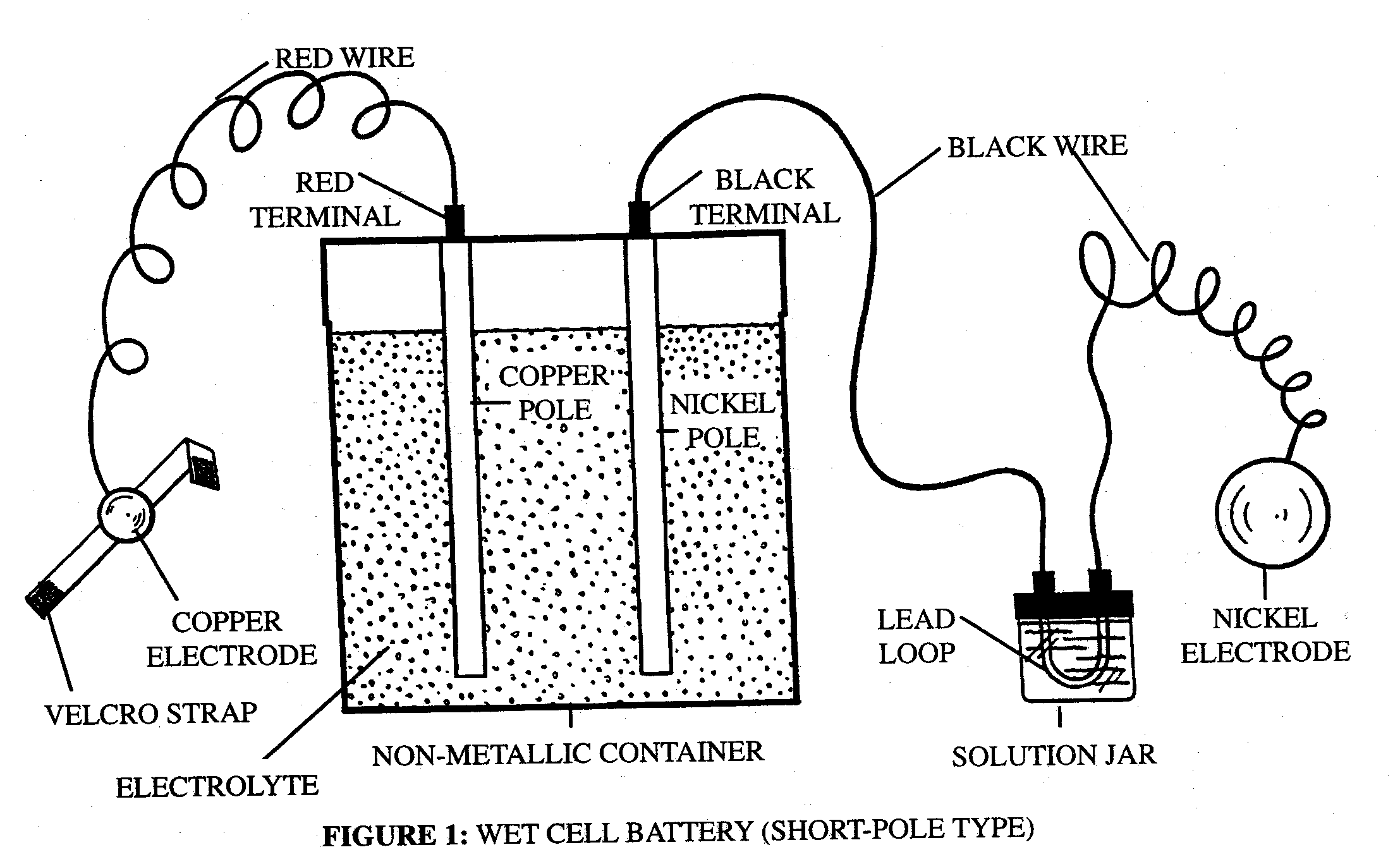
This is a close-up image of a wet cell battery and its components.
And this is a picture of an actual car battery

http://www.wisegeek.com/what-is-a-dry-cell-battery.htm
http://www.wisegeek.com/what-is-a-wet-cell-battery.htm
http://www.healingtherapies.info/images/Wet_Cell.bmp
http://www.global-b2b-network.com/direct/dbimage/50245303/Car_Battery.jpg
Apparently, though this sounds ludicrous it actually is real. A wet cell battery is a battery using chemical reactions to create electrical energy. Its electrolytes are contained in a liquid.
A dry cell battery, on the other hand, has its electrolytes contained in a low-moisture past. Wet cell batteries are used as car batteries as they are inexpensive and rechargable.
So car batteries are wet cell batteries after all.
This is a close-up image of a wet cell battery and its components.

And this is a picture of an actual car battery

http://www.wisegeek.com/what-is-a-dry-cell-battery.htm
http://www.wisegeek.com/what-is-a-wet-cell-battery.htm
http://www.healingtherapies.info/images/Wet_Cell.bmp
http://www.global-b2b-network.com/direct/dbimage/50245303/Car_Battery.jpg

Tuesday, January 19, 2010
Would you dare to use this toilet?

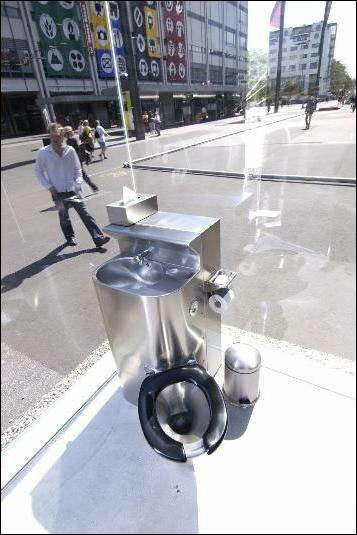
This picture shows a toilet in the middle of a busy street. Would you dare to use it?
Fortunately, the "glass walls" surrounding the toilet are actually one way mirrors. You can look outside at the busy street, but people outside can only see their own reflections.
Why is this so? When the light concentration on the outside is greater, the one-way mirrors reflect the scene of what is happening outside. However, inside it is darker and therefore the person inside the toilet can look out at the street without being seen.
Be careful though: When night falls and the street outside gets dark, the toilet will become less dark by comparison. If you choose to use the toilet then, it will lead to some rather embarrassing results!
http://loscuatroojos.com/wp-content/uploads/2009/02/one-way-mirror-inside.jpg
Touch Screens and Gloves don't go well together
If you ever try to use a touch screen with a glove on, it will most likely not work. Why is this so? Well, gloves are poor conductors of electricity. The touch screen requires a closed circuit to function. Our bodies are also conductors, and hence when we use our fingers on the touch screen the circuit closes and the touch screen will work. However, since gloves are poor conductors, the
circuit remains open and the touch screen will not work. This is the same for using a stylus. However, it is possible to modify your gloves simply to be able to wear them while using the touch screen. The link below shows how. It is pretty interesting. Have fun!
http://www.instructables.com/id/Making-A-Glove-Work-With-A-Touch-Screen/
Sources:
http://en.wikipedia.org/wiki/Touchscreen#Capacitive
http://en.wikipedia.org/wiki/IPhone#Screen_and_input
circuit remains open and the touch screen will not work. This is the same for using a stylus. However, it is possible to modify your gloves simply to be able to wear them while using the touch screen. The link below shows how. It is pretty interesting. Have fun!
http://www.instructables.com/id/Making-A-Glove-Work-With-A-Touch-Screen/
Sources:
http://en.wikipedia.org/wiki/Touchscreen#Capacitive
http://en.wikipedia.org/wiki/IPhone#Screen_and_input
Wednesday, January 6, 2010
Sticky Ice
Why does ice stick to our fingers when we remove it from the fridge? Well, apparently it is due to humidity in the surrounding air. When the surrounding air is wet and humid, your fingers are more moist and the ice will freeze when it comes into contact with the moisture on your fingers. Fortunately, on dryer days your fingers will not be wet and the ice will not stick.
Wednesday, July 1, 2009
Cells: An Analogy
This is an analogy of cells using animal cells. You probably may not have heard of some of the organelles.
Body: Earth
System: Continent
Organ: Country
Tissue: State
Cell: City
Cell membrane: City border with guards to monitor people entering and leaving the city
Free Ribosome: Individual shop
Ribosome on Rough Endoplasmic Reticulum (RER): Shop part of a franchise
RER: Franchise Headquarters
Smooth Endoplasmic Reticulum (SER): Recycling Plant
Vesicle pinched from RER: Transport vans for shop products
Vesicle pinched from SER: Transport vans for recycled products
Golgi Apparatus: Factory for processing, refining and modifying imported products
Vesicle fusing with Golgi Apparatus: Transport vans arriving and unloading goods
Vesicle pinching off from Golgi Apparatus: Transport vans with ready-to-go goods
Vesicle fusing with cell membrane: Transport vans unloading goods for export out of city
Cytoplasm: Free land
Nucleus: Government
Chromatins: High post officials
Centriole: Civil servants
Nucleolus: President/Prime Minister
Vacuole: Storage Plant
Mitochondria: Power Plant
If you happen to find that my analogy is incorrect at some parts, please let me know so I can change it. Thanks!
Between Chem and Bio
These are some pics of cells. These diagrams contain the different parts of cells and the less known organelles.


Thursday, April 30, 2009
Crystallisation
Here is an interesting video explaining crystallisation. It is a silent video but the images speak for it.
Tuesday, April 21, 2009
Separating Mixtures
Here are some ways to separate the following mixtures:
1) A mixture of non-magnetic materials and iron
Method: Use a magnet
2)A mixture of water, a solid that can dissolve in water and a solid that cannot (eg. water, salt and sand)
Method: filter the mixture to remove the sand, then use distillation to separate the salt and the water
3) 2 liquids that do not mix (eg. water and oil)
Method: Slightly more complicated. There is a special machine built to do so. It is called the API oil-water separator. You can find out about it in Wikipedia at this site: http://en.wikipedia.org/wiki/API_oil-water_separator
4) Air and petroleum
1) A mixture of non-magnetic materials and iron
Method: Use a magnet
2)A mixture of water, a solid that can dissolve in water and a solid that cannot (eg. water, salt and sand)
Method: filter the mixture to remove the sand, then use distillation to separate the salt and the water
3) 2 liquids that do not mix (eg. water and oil)
Method: Slightly more complicated. There is a special machine built to do so. It is called the API oil-water separator. You can find out about it in Wikipedia at this site: http://en.wikipedia.org/wiki/API_oil-water_separator
4) Air and petroleum
This is definitely more difficult... There is a special type of machine that is used. It is big, bulky and complicated. You can see it at these sites:
Subscribe to:
Posts (Atom)