1. Hydrogen bomb
These bombs are made from the isotopes of hydrogen. However, unlike what I originally thought, the hydrogen bomb was NOT used to end World War 2. In fact, the first hydrogen bomb was only detonated on November 1 1952, several years AFTER the end of World War 2. Oops!
2. Uranium bomb
A uranium bomb is created by a slow and complicated process. First, you need to obtain uranium which is highly enriched with over 90% U-235. This poses a problem as most uranium contains 0.7% U-235 at most. This is fortunate as it has helped to control the development and usage of nuclear weapons so far.
Once the required mass is obtained, it must be kept in at least 2 separate pieces until the moment of detonation, the pieces are then forced together quickly, causing an almost instantaneous and powerful explosion.
The first uranium bomb, nicknamed "Little Boy", was dropped on Hiroshima on August 6 1945.
3. Plutonium Bomb
Plutonium-239 is used to make plutonium bombs. This type of bomb is similar to a uranium bomb. However, very little plutonium-239 exists in nature. Unfortunately, plutonium-239 is easily produced by breeder reactors, which generate manmade plutonium-239.
The first plutonium bomb, nicknamed "Fat Man", was dropped on Nagasaki on August 9 1945, leading to the end of World War 2.
Sources:
Saturday, July 17, 2010

Saturday, May 15, 2010
Raw Food vs Cooked Food: The Scoop
Is raw food really healthier than cooked food? Let's look at all angles of the question.
Why do we cook food? Basically, food is cooked to kill germs and bacteria and to make it more palatable.
However, not all food requires cooking. For example, some foods like vegetables or fruits can be eaten raw after merely being washed with water. Indeed, sometimes if those types of food are cooked they will not taste nice.
Cooking food also causes its enzymes to denature. Science has also proven that vitamins and minerals in food which are vital for our growth and health are killed off by intense heat.
However, if we were to eat meat, fish or other such foods raw we would most likely throw up at the horrible taste. We would also end up falling ill as these foods contain high amounts of germs and bacteria when they are raw and uncooked.
Hence, to answer the question: For certain types of food which only need to be rinsed to cleanse the dirt off them, it is definitely better to eat them raw as it this will help to preserve the freshness of the food and sustain the vitamins and minerals contained in the food.
On the other hand, you had better not try eating meat or fish raw unless you want to contract salmonella or food poisoning!
Saturday, April 3, 2010
Eating Paper
We use paper for writing and doodling. But what happens if you eat paper?
In some cases, when people are starving and have no other options, they turn to paper as a source of food and nutrition until they can obtain proper food.
The disgustingness of the idea aside, let's look at the actual nutritional contents of paper.
Paper consists of fibre, which originates from plants and trees. Since we eat food which originate from plants, eating paper should technically be safe, right?
WRONG. Paper comes from plants, but it is unsafe to eat. Let's see why.
1. Ink
There is ink on most paper. Ink contains a high amount of chlorine, which is poisonous to the human body. Eating paper would be like drinking down a cup of ink or chlorine.
2. Lack of other nutrients
The only thing that paper contains is fibre and roughage. Apart from helping you to digest better and get rid of waste more easily, that doesn't help much and definitely won't help you to stay healthy.
So what's the verdict? If you ever lack food, don't try eating paper. It would be better not to eat than to eat things containing poisonous substances.
Friday, April 2, 2010
Carnivorous Plants
All plants make their own food through photosynthesis. But some plants also lure and catch insects for their meals.
Why do these plants need to do so? Normally, carnivorous plants grow in places where the soil quality is poor. It is more difficult for the plants to make sufficient food for itself to survive. Thus, to supplement its meals, the plant eats insects to make up for the loss in nutrition.
Why do these plants need to do so? Normally, carnivorous plants grow in places where the soil quality is poor. It is more difficult for the plants to make sufficient food for itself to survive. Thus, to supplement its meals, the plant eats insects to make up for the loss in nutrition.
Friday, February 19, 2010
Wednesday, February 3, 2010
Mythbusters: Escape from Alcatraz Part 2
Here's Part 2! Part 1 was mostly about the history behind the myth and how Frank Morris and the Anglin brothers actually started smuggling the materials and found a way out of their cells to store the materials. It also showed about the Mythbusters testing the direction the currents would carry the raft. Part 2 is about the Mythbusters building the raft, at the same time cracking jokes about it. Enjoy!
http://www.youtube.com/watch?v=ILu5Ug0lPjk
http://www.youtube.com/watch?v=ILu5Ug0lPjk
Thursday, January 28, 2010
Mythbusters: Escape from Alcatraz Part 1
This is a Mythbusters special. The myth says that there were three convicts on Alcatraz, Frank Morris and the Anglin brothers, and they built an inflatable raft from over 50 rubber raincoats.
The authorities say that they were headed for Angel Island and some of their personal belongings ended up near there. They were assumed to have drowned.
However, the Mythbusters tested their belief, which was that the inmates were smart enough to have used the tides to get to the Marin Headlands instead.
This is somewhat relevant to Physics as it plays on the principles of wind speed and direction, not to mention density. Admittedly it does not really have much to do with electricity. For that one, I am tracking down the Benjamin Franklin myth.
This is Part 1. I shall post Part 2 and 3 separately. Enjoy!
http://en.wikipedia.org/wiki/MythBusters_(2003_season)#Escape_From_Alcatraz
http://www.youtube.com/watch?v=fZI76hEkZRE
Thursday, January 21, 2010
Wet cell battery
We all know about dry cell batteries, which are the normal batteries we use for appliances like clocks, but have you ever heard of a wet cell battery?
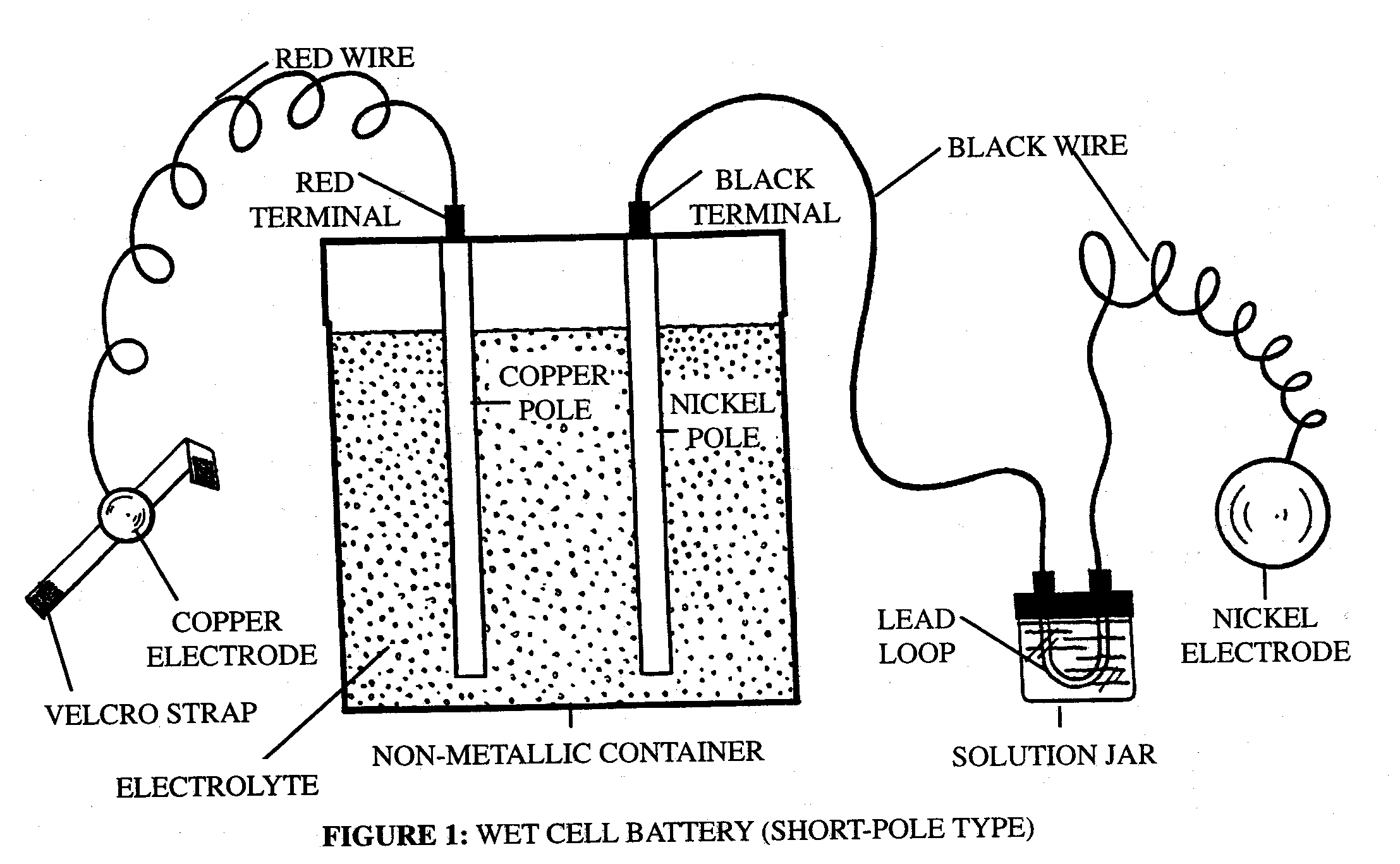
Apparently, though this sounds ludicrous it actually is real. A wet cell battery is a battery using chemical reactions to create electrical energy. Its electrolytes are contained in a liquid.
A dry cell battery, on the other hand, has its electrolytes contained in a low-moisture past. Wet cell batteries are used as car batteries as they are inexpensive and rechargable.
So car batteries are wet cell batteries after all.
This is a close-up image of a wet cell battery and its components.
And this is a picture of an actual car battery

http://www.wisegeek.com/what-is-a-dry-cell-battery.htm
http://www.wisegeek.com/what-is-a-wet-cell-battery.htm
http://www.healingtherapies.info/images/Wet_Cell.bmp
http://www.global-b2b-network.com/direct/dbimage/50245303/Car_Battery.jpg
Apparently, though this sounds ludicrous it actually is real. A wet cell battery is a battery using chemical reactions to create electrical energy. Its electrolytes are contained in a liquid.
A dry cell battery, on the other hand, has its electrolytes contained in a low-moisture past. Wet cell batteries are used as car batteries as they are inexpensive and rechargable.
So car batteries are wet cell batteries after all.
This is a close-up image of a wet cell battery and its components.

And this is a picture of an actual car battery

http://www.wisegeek.com/what-is-a-dry-cell-battery.htm
http://www.wisegeek.com/what-is-a-wet-cell-battery.htm
http://www.healingtherapies.info/images/Wet_Cell.bmp
http://www.global-b2b-network.com/direct/dbimage/50245303/Car_Battery.jpg

Tuesday, January 19, 2010
Would you dare to use this toilet?

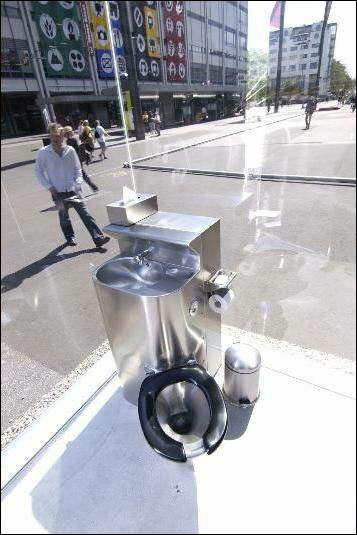
This picture shows a toilet in the middle of a busy street. Would you dare to use it?
Fortunately, the "glass walls" surrounding the toilet are actually one way mirrors. You can look outside at the busy street, but people outside can only see their own reflections.
Why is this so? When the light concentration on the outside is greater, the one-way mirrors reflect the scene of what is happening outside. However, inside it is darker and therefore the person inside the toilet can look out at the street without being seen.
Be careful though: When night falls and the street outside gets dark, the toilet will become less dark by comparison. If you choose to use the toilet then, it will lead to some rather embarrassing results!
http://loscuatroojos.com/wp-content/uploads/2009/02/one-way-mirror-inside.jpg
Touch Screens and Gloves don't go well together
If you ever try to use a touch screen with a glove on, it will most likely not work. Why is this so? Well, gloves are poor conductors of electricity. The touch screen requires a closed circuit to function. Our bodies are also conductors, and hence when we use our fingers on the touch screen the circuit closes and the touch screen will work. However, since gloves are poor conductors, the
circuit remains open and the touch screen will not work. This is the same for using a stylus. However, it is possible to modify your gloves simply to be able to wear them while using the touch screen. The link below shows how. It is pretty interesting. Have fun!
http://www.instructables.com/id/Making-A-Glove-Work-With-A-Touch-Screen/
Sources:
http://en.wikipedia.org/wiki/Touchscreen#Capacitive
http://en.wikipedia.org/wiki/IPhone#Screen_and_input
Wednesday, January 6, 2010
Sticky Ice
Why does ice stick to our fingers when we remove it from the fridge? Well, apparently it is due to humidity in the surrounding air. When the surrounding air is wet and humid, your fingers are more moist and the ice will freeze when it comes into contact with the moisture on your fingers. Fortunately, on dryer days your fingers will not be wet and the ice will not stick.
Wednesday, July 1, 2009
Cells: An Analogy
This is an analogy of cells using animal cells. You probably may not have heard of some of the organelles.
Body: Earth
System: Continent
Organ: Country
Tissue: State
Cell: City
Cell membrane: City border with guards to monitor people entering and leaving the city
Free Ribosome: Individual shop
Ribosome on Rough Endoplasmic Reticulum (RER): Shop part of a franchise
RER: Franchise Headquarters
Smooth Endoplasmic Reticulum (SER): Recycling Plant
Vesicle pinched from RER: Transport vans for shop products
Vesicle pinched from SER: Transport vans for recycled products
Golgi Apparatus: Factory for processing, refining and modifying imported products
Vesicle fusing with Golgi Apparatus: Transport vans arriving and unloading goods
Vesicle pinching off from Golgi Apparatus: Transport vans with ready-to-go goods
Vesicle fusing with cell membrane: Transport vans unloading goods for export out of city
Cytoplasm: Free land
Nucleus: Government
Chromatins: High post officials
Centriole: Civil servants
Nucleolus: President/Prime Minister
Vacuole: Storage Plant
Mitochondria: Power Plant
If you happen to find that my analogy is incorrect at some parts, please let me know so I can change it. Thanks!
Between Chem and Bio
These are some pics of cells. These diagrams contain the different parts of cells and the less known organelles.


Thursday, April 30, 2009
Crystallisation
Here is an interesting video explaining crystallisation. It is a silent video but the images speak for it.
Tuesday, April 21, 2009
Separating Mixtures
Here are some ways to separate the following mixtures:
1) A mixture of non-magnetic materials and iron
Method: Use a magnet
2)A mixture of water, a solid that can dissolve in water and a solid that cannot (eg. water, salt and sand)
Method: filter the mixture to remove the sand, then use distillation to separate the salt and the water
3) 2 liquids that do not mix (eg. water and oil)
Method: Slightly more complicated. There is a special machine built to do so. It is called the API oil-water separator. You can find out about it in Wikipedia at this site: http://en.wikipedia.org/wiki/API_oil-water_separator
4) Air and petroleum
This is definitely more difficult... There is a special type of machine that is used. It is big, bulky and complicated. You can see it at these sites:
Saturday, April 18, 2009
The aftermath of coke and mentos
Hi people, these are some choice pics from the coke and mentos experiment. Also, here is the wrap-up of our group's experiment.
Group members: Sarah Tay, Rachel Seah, Stella (who, by the way, took all the photos, thanks!) and me
Objective: To find out how the number of Mentos affects the height of the fountain.
Hypothesis: The more mentos put in, the higher the fountain will go.
Items used: Several tubes of mentos, three bottles of 1.5 litre coke, two meter rulers, two measuring cylinders, one of which got jammed, and one poncho that made me look like Little Red Riding Hood.

Procedure: We were supposed to drop in 10, 20 and 30 mentos respectively into each bottle of coke, but for the first one, Sarah only managed to unjam 2 mentos, so the rest were stuck when the explosion occurred.

Secondly, Sarah managed to fit 16 mentos into the measuring cylinder and pour it all in at once. Stella expertly captured a shot of the coke in mid-air.

Finally, we put in 10 mentos at once. Of course, being me, I put the stupid ruler crooked so the reading was inaccurate.

Our final conclusion was that we were correct, but up to a certain point the coke would stop dissolving the mentos and we would need to add more coke instead.
Here are explosion pics of other groups.


Tuesday, April 7, 2009
Separation of mixtures
How to separate mixtures:
1. Hand Separation
Example: Separating salt and sand
2. Filtration
Example: Sand and Water
3. Distillation
Example: Alcohol and Water
4. Chromatography, for separating different substances to determine whether they are banned substances
5. Etc. There are a whole lot of other techniques but they are too complicated and not required at this level.
http://www.chemteam.info/Matter/SeparationOfMixtures.html
Friday, April 3, 2009
The Elements
The periodic table of elements was thought up in 1869 by the Russian Chemist, Dmitri Mendeleev. They are in this order: 1. Hydrogen 2. Helium 3. Lithium 4. Beryllium 5. Boron 6. Carbon 7. Nitrogen 8. Oxygen 9. Fluorine 10. Neon 11. Sodium 12. Magnesium 13. Aluminium 14. Silicon 15. Phosphorus 16. Sulfur 17. Chlorine 18. Argon 19. Potassium 20. Calcium

Also, for those who enjoyed Miss Liang's elements song in class today, I am posting a video, probably by the same makers of Li Shan's Newton video as both use Lego.
Bibliography
http://www.flickr.com/photos/dullhunk/2053007240/
http://en.wikipedia.org/wiki/Periodic_table_%28large_version%29
http://en.wikipedia.org/wiki/Periodic_table
Tuesday, March 31, 2009
National Vertical Marathon 2009
This year's national vertical marathon was held on 8 Feb 2009, Sunday, at Republic Plaza. Republic Plaza is 280 metres tall with 66 floors and 1 basement. It has 15 double-decker vertical lifts and is one of the three tallest skyscrapers in Singapore.
Links:
http://en.wikipedia.org/wiki/Republic_Plaza,_Singapore
Links:
http://en.wikipedia.org/wiki/Republic_Plaza,_Singapore
Friday, March 27, 2009
Tallest buildings
There is a three-building tie for the tallest building in Singapore. They are:
1.OUB Centre 280 m, 63 floors
2.UOB Plaza 1, 280 m, 66 floors
3. Republic Plaza, 280 m, 66 floors
As for the world's tallest buildings, here they are!
1. Burj Dubai, Dubai, The United Arab Emirates
Built in 2009
162 floors, 818 m
2.Taipei 101, Taipei, Taiwan
Built in 2004
101 floors, 508m
3. World Financial Center, Shanghai, China
Built in 2008
101 floors, 492m
Bibliography:
http://en.wikipedia.org/wiki/List_of_tallest_buildings_in_Singapore
http://www.infoplease.com/ipa/A0001338.html
Subscribe to:
Posts (Atom)